When offices started reopening in 2022 and 2023, most companies announced they were going hybrid. Two days in, three days in, "flexible," whatever the right word was for "we're not fully remote but we're also not going back to five days a week." Everyone said it was the future.
A lot of it wasn't designed at all. It was "you can work from home some days" implemented as policy without any thought about how the work would actually happen. The result, for many teams, was the worst of both worlds: the coordination overhead of remote work combined with the interruption-heavy environment of an office, with neither set up to function well.
The two-tier problem
The most common failure mode of poorly-designed hybrid work is the emergence of two tiers: the people who are in the office more often, and the people who are remote more often. In principle, it's supposed to be equal. In practice, it never is.
The people in the office have access to informal conversations. They're in the room when decisions get made in hallways or during lunch. They get visibility with leadership just by being physically present. They hear things before the official announcement. The people who are remote don't get any of that, even if they're technically allowed to be remote the same number of days.
This isn't intentional discrimination. It's gravity. Physical proximity creates informal information flow, and informal information flow determines who's in the know. If you have a hybrid policy but haven't dealt with this, you have a two-tier team and you've probably already lost some good people over it.
The meeting room problem
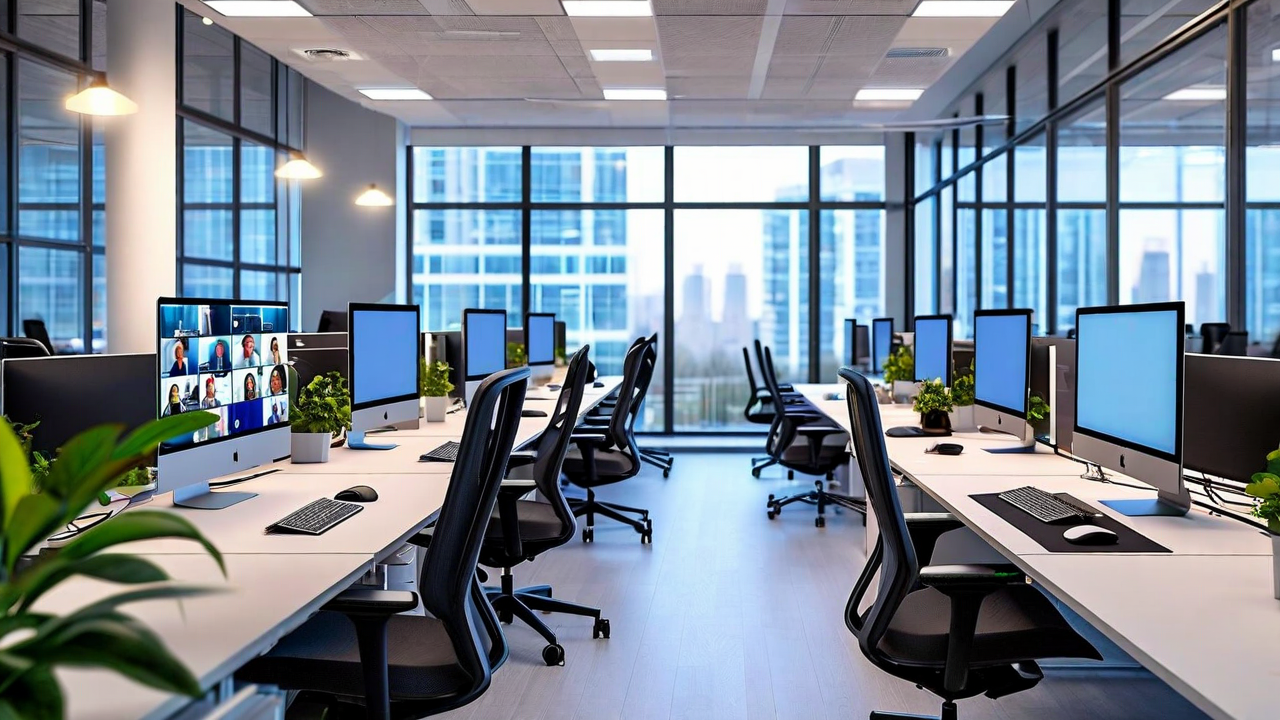
Hybrid meetings are where the design failure is most visible. Half the team is in a conference room around a table. Half the team is on individual video calls. The in-person group can hear each other naturally, see body language, have side conversations easily, and use a whiteboard. The remote group has a rectangle with faces in it and audio that cuts out when two people talk at once.
These are not equivalent experiences, and the people who've been to both know it. The remote participants are structurally disadvantaged. They jump in less because the conversational rhythm is harder to read. They miss the whiteboard session. They can't see who's making eye contact with whom or picking up the thread of a side conversation that changes the direction of the discussion.
There's a fix for this, but companies hate implementing it because it feels excessive: every person joins from their own device, even the people in the office. No one has the conference room advantage. Everyone's in the same rectangle. It works, but you have to get over the absurdity of twelve people sitting three feet apart from each other in an office, each on their own laptop with headphones in.
When "flexible" means "anxiety"
Many hybrid policies are technically flexible but create constant low-grade uncertainty. "Come in when it makes sense." "Be here for important meetings." "Use your judgment." These policies sound reasonable. They require people to constantly interpret ambiguous signals about what's expected.
Should I come in today? Will my manager notice if I'm remote again? If I miss this in-person meeting is that going to be held against me? Am I the only person on my team who's remote three days instead of two? This isn't paranoia — it's a reasonable response to unclear norms. Ambiguity about expectations is draining. It's cognitive overhead that has nothing to do with actual work.
The hybrid policies that generate the least anxiety are the ones that are explicit: here are the specific days or occasions where in-person matters, here are the things you can always do remotely, here's how we make decisions about which is which. Even if the explicit policy is less "flexible" than the ambiguous one, people do better with it.
What designed hybrid actually looks like
The companies that've made hybrid work genuinely work tend to approach it with an architecture question: for what kinds of work is physical presence actually valuable, and for what kinds is it irrelevant or actively worse?
The honest answer for most knowledge work teams: physical presence is genuinely valuable for relationship-building, creative brainstorming where energy and spontaneity matter, complex conflict resolution, and onboarding new people. It's not meaningfully better than remote for focused deep work, status updates, routine coordination, or individual execution tasks.
From that analysis, you design in-person time around the things that actually benefit from it. Quarterly or biannual gatherings focused on the high-value synchronous activities. Optional coworking for people who want the energy of a shared space. And then a remote-first default for everything else, with remote-first meaning the async tools and documentation practices that make remote work actually work.
The companies getting it right
The teams doing hybrid best tend to be the ones that were remote-first first and added in-person intentionally, not the ones that were office-first and tried to accommodate remote as an accommodation. They have the async tools, the documentation habits, and the communication norms already in place. Adding physical gatherings on top of that infrastructure is straightforward. Trying to retrofit remote-first infrastructure onto an office-first culture while also managing two different work environments at once is genuinely hard.
The companies that declared hybrid and then did nothing to design it are struggling — dealing with the ongoing friction of two-tier dynamics, poorly run meetings, and ambiguous expectations. Some have quietly returned to office mandates to resolve the coordination problems. Some have gone fully remote to cut the Gordian knot. The ones in the middle are mostly tired.
Hybrid is a viable model. It's just not a viable default. It requires explicit design to work, and most companies weren't willing to do that work.